
5 Dangerous Crypto Mistakes That Cost Beginners Over 50 Everything
Crypto Security June 16, 2025 Crypto Mistakes No One Talks About – But Everyone Pays For Most never

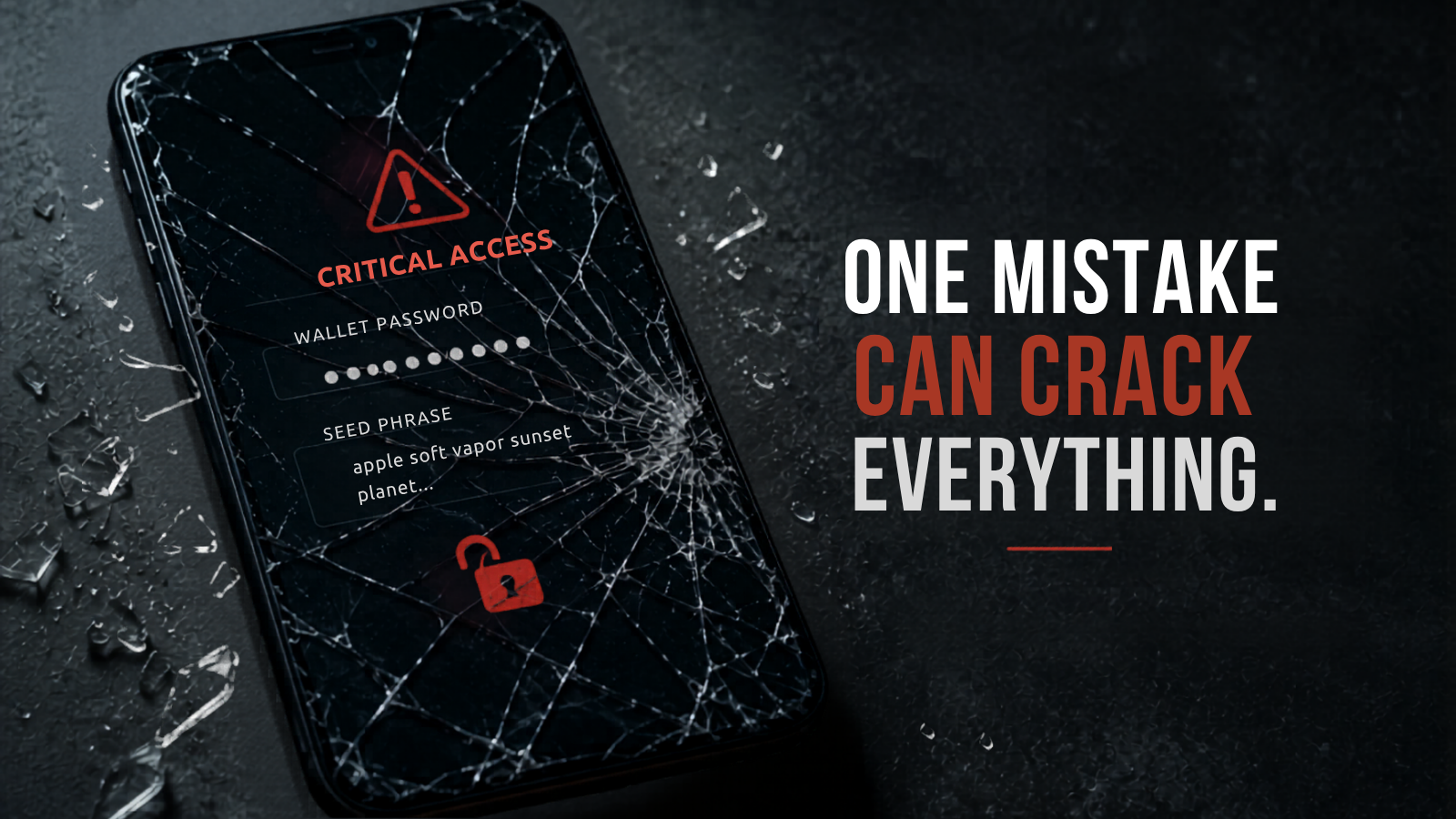
Let me ask you something. Where are your crypto passwords right now?
If your answer is somewhere in your phone, in a notes app, in a Google doc, in your email drafts, or, and I say this with love, in your head, then we need to talk. Because these are the crypto password mistakes that are quietly setting people up for a disaster they never see coming; not necessarily today, not necessarily tomorrow, but at exactly the wrong moment.
Here’s the thing most people don’t realize: crypto password mistakes are rarely about weak passwords. They’re about where those passwords live. Because the location of your access information is just as important as the information itself, and most people over 50 who are newer to crypto have never been told that.
So let’s fix that right now.
The crypto password mistakes that hurt people most aren’t dramatic. They’re quiet. A phone that breaks. A cloud account that gets hacked. A notes app that nobody else can get into. Small oversights with enormous consequences.
In the wild world of crypto, there’s a gap between what people think is safe and what actually is. And for people who came to crypto later in life, without years of digital security habits baked in, that gap tends to be wider than most.
Most people over 50 store passwords the way they were taught to manage important information: write it down somewhere, or remember it. Both of those instincts make complete sense in the physical world. In the digital world of crypto, both of those instincts, applied the wrong way, can cost you everything.
Writing it down is actually the right idea. But where you write it down matters enormously. And remembering it? In crypto, if that memory fails, through illness, incapacity, or simply forgetting, so does everything behind it. These are the crypto password mistakes that don’t feel like mistakes until it’s too late to fix them.
This is the most common one and honestly, it makes complete sense why people do it. Your notes app is right there. It’s convenient. It’s private, or so it feels. You can access it anywhere. So you jot down your exchange login, your wallet password, maybe your seed phrase, and you move on with your day.
Here’s the problem with that. Notes apps, whether it’s Apple Notes, Google Keep, Samsung Notes, or any other, are connected to your device and your cloud account. If your phone gets stolen, hacked, or lost, that information is potentially accessible to whoever has it. If your cloud account gets breached, and cloud account breaches happen constantly, as the cybersecurity guidance from America’s Cyber Defense Agency will tell you, everything you stored there is exposed.
And here’s the one nobody talks about: if something happens to you and your phone is locked, your family cannot get into your notes app any more than they can get into your crypto accounts. These crypto password mistakes don’t just create a security risk; storing passwords in a notes app creates an access problem for the people you love at exactly the moment they need that access most.
Another incredibly common one. You create a new crypto account, you get the confirmation email, and somewhere in that thread is your login information. Or you email yourself a note with your passwords so you can find it easily. It feels safe because email feels personal and private.
It isn’t. Email is one of the most frequently targeted accounts in any kind of hacking attempt. If someone gets into your email, through a phishing scam, a data breach, a reused password, they now have access to every crypto account credential you ever sent yourself. That’s not a theoretical risk; it’s one of the most documented crypto password mistakes that leads to real financial loss.
And again, the access problem: if something happens to you and your family can’t get into your email, everything stored there is gone along with you.
Here’s one that feels foolproof right up until it isn’t. You created the password. You’ve typed it hundreds of times. You know it cold. Why would you ever need to write it down?
Because memory is not a reliable security system. Not for anyone, and especially not under stress. A medical emergency, a sudden illness, a cognitive change, these things happen, and when they do, the information that lived only in your head becomes inaccessible. Just like that.
Relying on memory is one of the crypto password mistakes that feels the least like a mistake, right up until the moment it becomes one. And at that point, there’s usually no way back in.
Your laptop has all your crypto accounts saved. Your phone has all your passwords in a document. Everything is in one place, which feels organized and efficient. Until that device breaks, gets stolen, or simply stops working.
Devices fail. It’s not a question of if; it’s a question of when. And when the device that holds all your crypto access information goes down, everything behind it becomes inaccessible until you can recover it, if you can recover it at all. Keeping all your access information tied to a single device is one of the crypto password mistakes that turns a bad day into a financial crisis.
This might be the most important one of all, and it’s these type of crypto password mistakes that almost nobody thinks about until it’s too late. You’ve been thinking about your passwords entirely from your own perspective: can I get in? Do I know where everything is? Can I access my accounts?
But here’s the question you also need to be asking: could anyone else get in if they needed to? A spouse. An adult child. A trusted person who might need to step in during an emergency. Because in crypto, if the right information isn’t documented in a format someone else can actually find and use, nobody gets in. Not without you there to guide them. And if you can’t be there, everything stops.
Crypto password mistakes don’t just put your access at risk. They put your family’s access at risk too. And that’s the part most people never think about until it’s already a problem.
Let’s be real here; safe crypto password storage is not complicated, but it does require doing something different from what most people are currently doing. Here’s what it actually needs to look like.
Offline first. Your crypto access information: passwords, seed phrases, account details, should not live on any device or in any cloud account. The moment it’s digital, it’s vulnerable to hacking, device failure, and access problems. Offline means written down, physically, in a secure location.
Organized, not scattered. A sticky note here and a napkin there is not a system. Your access information needs to be in one place, clearly organized, in a format that someone else could follow if they needed to — because at some point, they might.
Secure but accessible to the right people. Locked away so tightly that nobody can find it in an emergency is almost as bad as not having it at all. The right balance is: secure from the wrong people, accessible to the right ones, with at least one trusted person who knows exactly where it is and how to use it.
This is exactly what The Vault was built to solve; a structured, physical, offline record where you document every account, every access detail, every piece of critical information your family would need, organized clearly, stored securely, and actually usable when it matters most. Find it at thecryptocracker.com.
Here’s what I want you to take away from all of this. Crypto password mistakes are not made by careless people. They’re made by people who never got told that where you store access information matters just as much as having it in the first place. Nobody sat you down and explained that a notes app is a liability, that email is a target, that memory is not a backup plan.
Well, now you know. And knowing is the easy part. The hard part is doing something about it before life gives you a reason to wish you had.
So I ask you this: if your phone disappeared tomorrow, would your family be able to access your crypto? Would you?
If the answer is anything other than a confident HELL YES, that’s the crypto password mistake that needs fixing. Right now. Not someday. Now.
If something happened to you today — could your family actually access your crypto?
What you need to fully understand is this: if there is no access, there is no crypto. Full stop.
Most people assume someone will figure it out. They won’t. There’s nothing clear for them to follow. No record. No instructions. No starting point. Just accounts they don’t know exist and systems they can’t get into. That’s just wishful thinking and helps no one.
This doesn’t only apply to your crypto. It’s everything. Your accounts. Your passwords. Your insurance. Your documents. Your decisions. All of it becomes a cluster-mess the moment someone else has to step in. To think this could have all been prevented if you had just left them with all the information they would actually need.
That’s where things fall apart. Not in the market. Not in the technology. Right here.
This is exactly why The Vault System exists. It puts everything in one place, clearly organized, offline, and usable, so the people you love are not left trying to figure everything out in the worst moment of their lives.
You don’t need this for yourself. You need this for the people who would be left dealing with everything without you. This isn’t about what happens to you. It’s about what happens to the people you leave behind.
→ Explore The Complete Vault System at thecryptocracker.com
Crypto Security June 16, 2025 Crypto Mistakes No One Talks About – But Everyone Pays For Most never

Important: Nothing in this post is financial, tax, or legal advice. All numbers used here are illustrative examples only, not
One More Step
Check your email to confirm and unlock The Exposure Report.
Think you’re invisible in crypto?
Enter your email below to see how exposed you really are.
By entering your email, you agree to receive The Exposure Report and occasional emails from The Crypto Cracker. You can unsubscribe at any time.
Check your inbox to confirm your email and unlock the report. If you don’t see it, check spam or promotions.